Friday, February 14, 2014

The Demise of the Coupe


When I went car shopping recently, I noticed a lack of coupes.  Trucks, crossovers, and sedans dominated the scene.  The only coupes I looked at were the Nissan Altima, Dodge Challenger, and Ford Mustang.  I know there are a handful of other car companies that make coupes, but the number of models, and the volume of coupe sales has dwindled sharply from twenty years ago.   
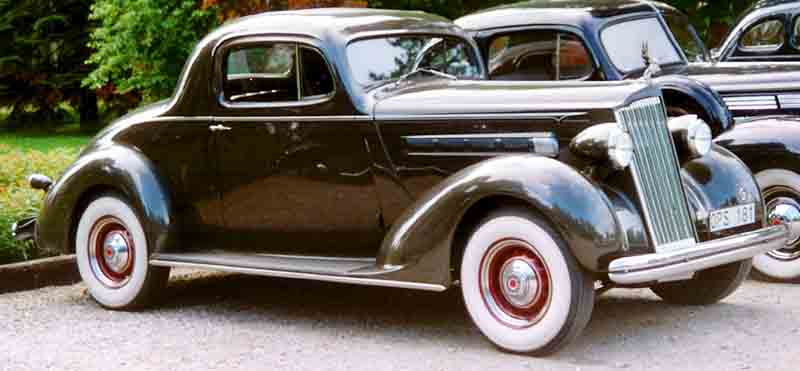
File:Packard 120 Eight Business Coupe 1936.jpg

The concept of the coupe originated in the 19th century as a closed carriage with a single seat.  Later  it became a term used to describe an enclosed car with seats for two or three people.  A number of car companies in the 1930s and 1940s made what they called business coupes, cars with no rear seat built for traveling salespeople, or folding seats like the kind you get with an extended cab pickup truck.  The lack of a back seat is what made the car different from a two door sedan, which, like a coupe, had two doors but also a full back seat.   


Perhaps the zenith of the coupe came and went with the original Ford Mustang.  Launched exactly 50 years ago, the Mustang was an instant hit and has since become an American icon.  Based on the Ford Falcon sedan, it was marketed as a 2+2 coupe, the "+2" designating the small, occasional use backseats. 

Growing up, there were coupes everywhere.  By then the concept of a coupe had merged with a 2 door sedan and the two were used interchangeably.  Just about every popular car was offered in sedan and coupe form--midsize and full size family cars like Oldsmobiles, and even smaller cars like the Plymouth Reliant and Ford Tempo.  There were also a number of sporty cars to compete with the Ford Mustang and its main rival, the Chevy Camaro--the Toyota Celica, Honda Prelude, Ford Probe, and Mitsubishi Eclipse were popular at the time.  Today, with the exception of the Mustang and resurrected Camaro, all those cars are gone. 


In 2004, Mercedes launched the CLS, a "four-door coupe" based on their midsize E platform.  It didn't matter that a four-door coupe was an oxymoron, or that the car was no more capable than an E55.  The CLS looked sensational and started a trend.  Today there is no shortage of four-door coupes, including cars from Audi, BMW, VW, and Jaguar.  Ford jumped on the bandwagon with the new Fusion, as have other sedans, like the new Chrysler 200, and Chevy Impala.  

I suspect the primary reason for the demise of coupes is the shift in consumer preferences, but it may also have something to do with the styling and capabilities of the modern sedan.  Gone is the square, upright styling of yesterday's sedans.  It's been replaced by a sleeker look that has blurred the lines, making four door cars as desirable as the coupes of yesteryear.  But while the number of coupes sold in the market continues to diminish, I doubt they will ever completely go away.  Coupe styling, no matter how striking, or well executed on a four door car, will always be a compromise.  Sedans will always lack the purpose-built look of a two-door sports car or grand tourer.  They will never have the wild sense of romance and adventure, never have their names uttered in the same breath as the Porsche 911 or Jaguar XK.  

True two-door sports cars and GTs offer the promise of an adventure, a spur of the moment trip to wine country, a drive to the Florida Keys by way of Miami Beach, or weekend getaway to ski.  A sedan, even one labeled a coupe, is still a sedan and the automotive equivalent of date night.  Yes, there is the promise of adventure, an opportunity to go interesting places, but at the end of the evening you still have to go home and pay the baby sitter.                        

Thursday, January 30, 2014

The Little Demon that Could


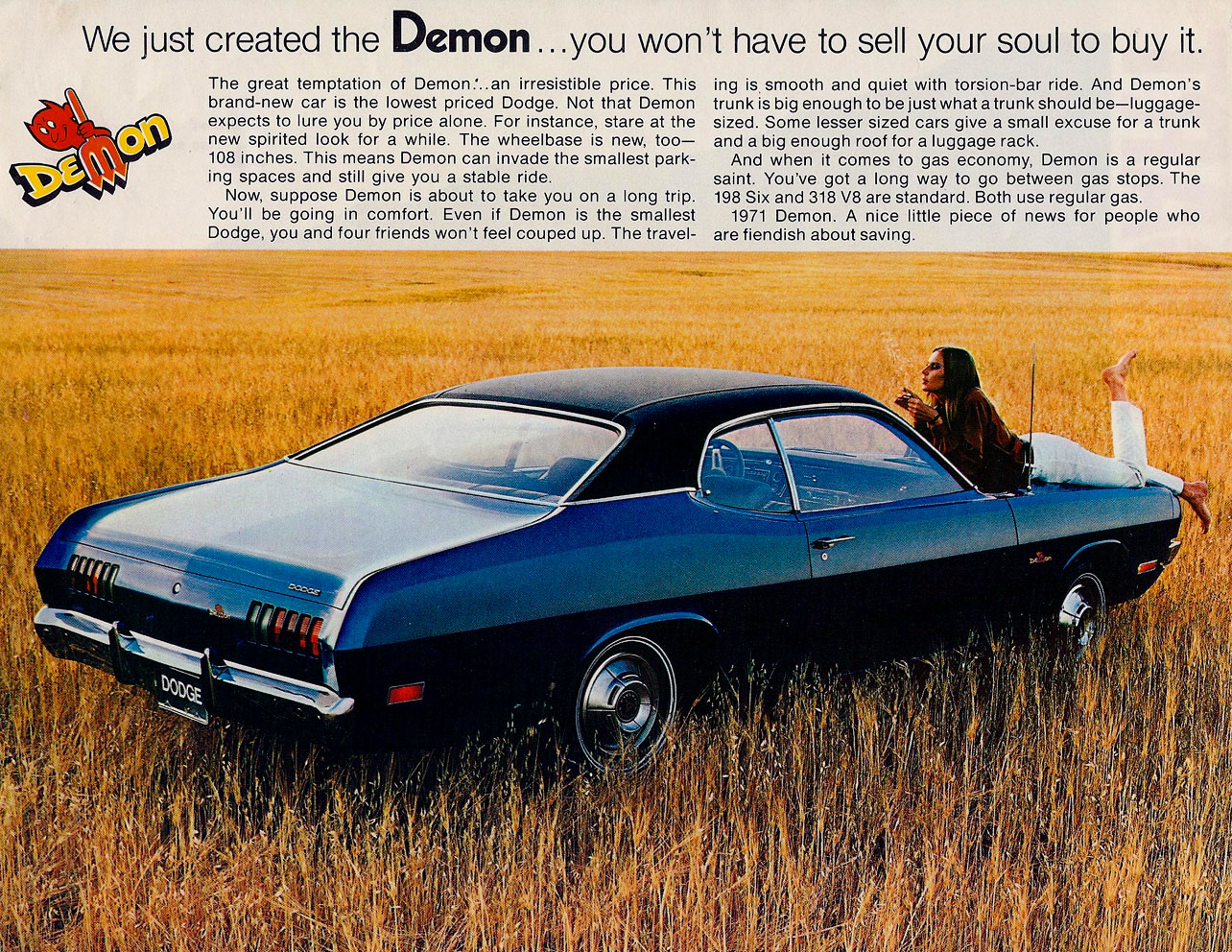
During my formative years, my parents owned a 1971 Dodge Demon.  It was the family hand-me-down car that I called the "Dentmobile" because just about everyone managed to put a dent in it at one time or another.  My grandfather, who bought the car new.  My aunt who learned to drive on it.  My mother who drove it every day for nine years.  And once I side swiped it with a trailer I was pulling behind a riding lawnmower. 


There was nothing special or fancy about the Demon.  Except for an automatic transmission, it was as basic as basic transportation gets.  School buses and U-haul trucks are more lavishly equipped.  The Demon didn't just have rubber floor mats, it had rubber on the floor in place of carpet.  Heat and ventilation were abstract theories--there were vent boxes below the dash opened for fresh air, but they let in other things like leaves and water.  The heater had two speeds, "Low" and "Hi".  Both settings were equally feeble and blew as much air as a hamster through a straw. 

The Demon had one redeeming quality--stalwart dependability.  Powered by a 198 cubic inch Slant 6 engine, it always started on the second try, coughing and settling into a lumpy, agrarian  idle.  One cold January, my aunt and uncle visited from Phoenix.  The temperature dropped below zero the day they were supposed to leave, and their rental car failed to start.  My parents offered to take them to the airport in my dad's Oldsmobile Cutlass.  But it too failed to start.  Only the Demon, sitting at the bottom of the driveway under fresh snow, dormant since before Christmas, started.  On the second try. 

When I was in high school, my parents gave me the choice of the Cutlass or the Demon.  I chose the Cutlass because it had bucket seats and the Olds 350 Rocket engine.  But I sometimes wonder what would have happened if I had taken the Demon.  It probably would have needed less care and feeding.  The Cutlass was a thirsty beast with gas mileage measurable in feet per gallon.  It also racked up a daunting list of repairs, requiring just about everything, including a transmission rebuild.  Adding it up, car payments on a new Cutlass would have been cheaper.

In the early 1990s I happened upon the Demon again in midtown KC.  It was the same car, rustier than ever, its blue paint faded like acid washed denim jeans.  It sported all the same dents, plus some new ones, and still had the bumper sticker my family added that said, "Mom knows best, buckle up."  

Twenty years later, I still think about that Demon.  It was a simple car, one with only one objective: providing basic, dependable transportation.  That idea seems quaint and old fashioned today.  In an era where the cheapest new cars come standard with air conditioning and power windows, the idea of rubber floor mats and vent boxes seems as antiquated as hand cranks and magnetos.  There probably will never be a market for a car that basic in the U.S again.  

Even so, I'd like to think that Demon is still out there somewhere, coughing to life on the second try and ambling down the road.        

Friday, December 13, 2013

How to Buy a Car: Part 6 - When to Walk

No matter what happens in the finance office, or at anytime during the car buying process, remember this:  You can always walk. 


If for any reason you don't like the deal, or the deal changed for the worse between the time you left the sales person and entered the finance office, you can walk. 

Even if you signed a piece of paper for the salesman, committing to buying a car, you can walk.  Only when you've signed the final contact in the finance office, are you obligated to take possession of the car.     

There are always good reasons to walk away from a deal, and you should always have that option.  But there are two things to be conscious of if you do decide to walk away:

  1. The deal may or may not get better by walking away.  Yes, it's possible to get a better deal by walking and coming back later, but it might not.  

  1. You may not get a better deal someplace else.  Dealers have access to the same information you do and they keep a vigilant eye on their competition, including prices and sales volumes.  They also use the same tools to price their cars and appraise trade ins. 

If you do walk away from a deal, you have to be prepared to start over from square one.  Car buying is a lengthy process that takes several hours or more.  If you've already invested a whole Saturday or evening negotiating a deal, you have to decide if it's worth spending more of your time to try and get a better deal. 

This is where the time value of  money comes in--how much is it worth for you to try and get a better deal?  Are you willing to give up another evening or Saturday?  Take time off from work?  Miss out on an activity you enjoy?  You have to ask yourself:  "Is what I'm giving up, worth what I'm getting in return?"

It's a question only you can answer.  And to help answer it, we've come back full circle to the beginning of this series--the key to knowing when to walk is information.  It's another reason why it's important to do your research up front and gather enough information to make the best decision.