Showing posts with label Dodge. Show all posts

Thursday, January 30, 2014

The Little Demon that Could


During my formative years, my parents owned a 1971 Dodge Demon.  It was the family hand-me-down car that I called the "Dentmobile" because just about everyone managed to put a dent in it at one time or another.  My grandfather, who bought the car new.  My aunt who learned to drive on it.  My mother who drove it every day for nine years.  And once I side swiped it with a trailer I was pulling behind a riding lawnmower. 


There was nothing special or fancy about the Demon.  Except for an automatic transmission, it was as basic as basic transportation gets.  School buses and U-haul trucks are more lavishly equipped.  The Demon didn't just have rubber floor mats, it had rubber on the floor in place of carpet.  Heat and ventilation were abstract theories--there were vent boxes below the dash opened for fresh air, but they let in other things like leaves and water.  The heater had two speeds, "Low" and "Hi".  Both settings were equally feeble and blew as much air as a hamster through a straw. 

The Demon had one redeeming quality--stalwart dependability.  Powered by a 198 cubic inch Slant 6 engine, it always started on the second try, coughing and settling into a lumpy, agrarian  idle.  One cold January, my aunt and uncle visited from Phoenix.  The temperature dropped below zero the day they were supposed to leave, and their rental car failed to start.  My parents offered to take them to the airport in my dad's Oldsmobile Cutlass.  But it too failed to start.  Only the Demon, sitting at the bottom of the driveway under fresh snow, dormant since before Christmas, started.  On the second try. 

When I was in high school, my parents gave me the choice of the Cutlass or the Demon.  I chose the Cutlass because it had bucket seats and the Olds 350 Rocket engine.  But I sometimes wonder what would have happened if I had taken the Demon.  It probably would have needed less care and feeding.  The Cutlass was a thirsty beast with gas mileage measurable in feet per gallon.  It also racked up a daunting list of repairs, requiring just about everything, including a transmission rebuild.  Adding it up, car payments on a new Cutlass would have been cheaper.

In the early 1990s I happened upon the Demon again in midtown KC.  It was the same car, rustier than ever, its blue paint faded like acid washed denim jeans.  It sported all the same dents, plus some new ones, and still had the bumper sticker my family added that said, "Mom knows best, buckle up."  

Twenty years later, I still think about that Demon.  It was a simple car, one with only one objective: providing basic, dependable transportation.  That idea seems quaint and old fashioned today.  In an era where the cheapest new cars come standard with air conditioning and power windows, the idea of rubber floor mats and vent boxes seems as antiquated as hand cranks and magnetos.  There probably will never be a market for a car that basic in the U.S again.  

Even so, I'd like to think that Demon is still out there somewhere, coughing to life on the second try and ambling down the road.        

Tuesday, September 17, 2013

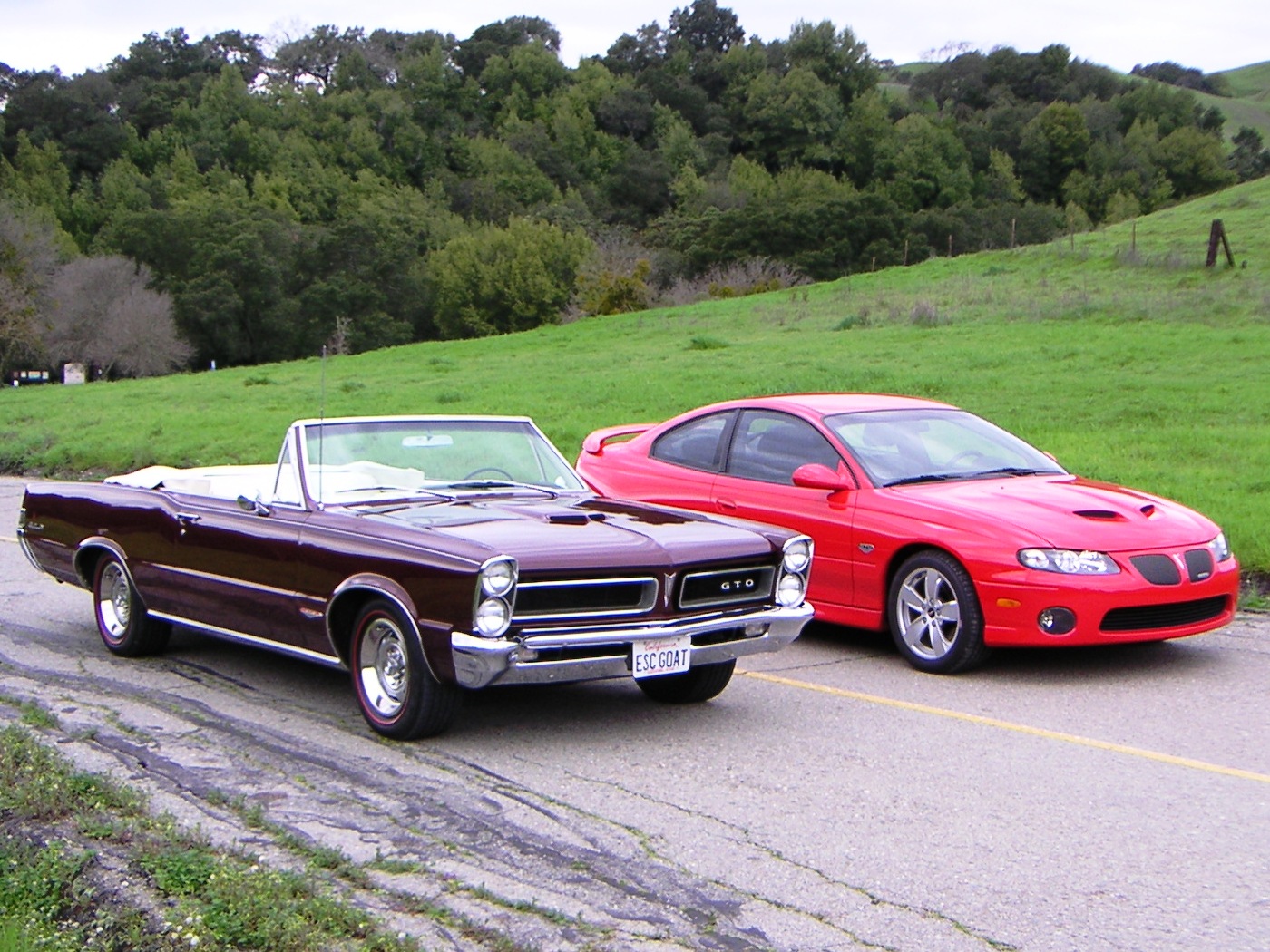
$15,000 Question: Pontiac GTO

The premise was simple:  Stuff a performance V8 into a midsize car.  The result became the legendary Pontiac GTO and launched the muscle-car era fifty years ago.  Within a year, hot versions of Oldsmobiles, Chevrolets, Buicks, Fords, Mercurys, and Mopars were rolling off showroom floors and on to drag strips across America. 

File:40 Years of GTOs 1965 to 2005.JPG

Today it's hard to find an original, clean GTO from the golden age of muscle cars for under $20K.  But for $15K, you can buy a badged engineered Holden Monaro from the Land Down Under that's gussied up to look like a modern version of the legendary Pontiac. 

File:2001-2002 Holden V2 Monaro CV8 coupe 03.jpg

Admittedly, the idea of an Australian built Pontiac GTO seems like pasting a picture of a Clydesdale on a can of Foster's Lager and calling it Budweiser.  If you look close enough, that's exactly what GM did.  The car looks exactly like a Holden Monaro with the grille of a Pontiac Grand Prix.  Inside it has an interior that looks more at home in an Opel, right down to the Blaupunkt stereo. 


But the biggest problem is that the GTO doesn't stand out.  It doesn't have the presence of the old GTO, or even modern cars like the Ford Mustang or Chrysler 300.  From a distance, it's easily confused for a Chevy Cavalier or the Pontiac version of the Cavalier, whatever it's called. 

All that changes, if you actually drive it.  Powered by the LS1 and LS2 V8 engines from the Corvette, the GTO has serious performance credentials, blasting to 60 MPH in under five seconds and through the quarter mile in 13 seconds flat.  Better still, it sounds great and even handles well with its independent suspension.  
  

It's persona is that of Hugh Jackman, playing Wolverine, hiding in a musical about French peasants, based on a Victor Hugo novel.  Somewhat confusing, but for the budget enthusiast, looking for a V8 powered sleeper, it's really hard to beat. 

Friday, May 31, 2013

Dodge Dart: What's in a Name?

File:63Dart170 4D.jpg

I like the Dodge Dart.  It is essentially a stretched version of the Giulietta and therefore the closest thing you can get to a new Alfa Romeo in the US.  The problem is its name. 

The dictionary defines dart as a small pointed missile that can be thrown or fired or as a verb meaning to move or run somewhere suddenly or rapidly.  I suppose a car that moves rapidly is good.  But the 5th grade boy in me knows that I can rhyme Dart with fart and shart.  Given the quality of Chrysler's small cars over the past decade, either rhyming word is appropriate. 

The problem is Chrysler doesn't have many historical names to draw on for small cars.  Valiant, Duster, and Volare were used for small Plymouths of the 1960s and 1970s.  Dodge had the Dart, Demon, and Aspen.  Incidentally the Demon was supposed to have been named the Beaver, which would have caused even more problems.  More recently Chrysler has used Omni, Aries, Reliant, Shadow, Sundance, and Neon for small cars.  Not much to work with there either. 

Chrysler bought AMC in the 1980's, which gave them the Eagle and Alliance.   Going to larger Dodge cars, there's the Monaco, Lancer, Coronet, Polara and Stratus.  On the Plymouth side there's the Belvedere, Satellite, and Fury to name a few.

My favorite Dodge name is the Intrepid, which was used on their large car made from 1992 to 2004.  Dodge must have decided to skip Intrepid and go with a classic name to invoke nostalgia.  Dart is better than naming a car the XR4Ti or some other seemingly random combination of letters and numbers.  But what does a Dodge Dart mean to people today?  How does the name rate against nameplates like Civic, Corolla, Focus, Cruze, and Elantra? 

Then again, those other nameplates don't do much for me either.  However, I've owned both a Civic and Corolla and think of them as loyal, dependable, small cars which could dart through traffic. 

Maybe Dart isn't so bad after all… just as long as they don't make a Swinger edition...

Monday, November 9, 2009

Mr. Automatic

There was a time when I'd only buy a car with a manual transmission. Slushboxes, as automatics are sometimes called, were boring to my way of reckoning and they robbed power from the engine. I liked revving the engine, snapping off crisp up-shifts, and listening to the exhaust crackle as I downshifted. It was a way to satisfy my inner Walter Mitty as I pretended to race at Watkins Glen or Monaco.

Somewhere along the line of marrying and having kids, I began buying cars with automatics. I didn't mind the car shifting itself in stop and go traffic, or when I needed to retrieve the lost binky from the backseat. But somewhere along the march of time, I realized I now would prefer to own an automatic over a manual transmission. This truth became self evident recently when I looked at the new Dodge Challenger and realized I'd rather own the auto instead of the six-speed manual with pistol-grip shifter. In fact most of the cars I've been dreaming about lately have automatics, from Jaguars, AMG powered Mercedes Benzes, and the Challenger. In fact, there are only a handful of modern cars I'd own today with a manual transmission.

To be fair, slushboxes have come a long way in the last ten years. Most of them are much tighter, more efficient and some of them offer a choice to let you do the shifting yourself. Ironically, we have Porsche and Ferrari to thank for this. Porsche began offering a Tiptronic transmission in the early 1990s. Licensed versions of this gearbox even made their way into cars like my Hyundai Sonata and it worked surprisingly well. Ferrari pioneered the "flappy paddle" gearbox, an automatic with two paddles mounted on the steering wheel to shift gears. Six time F1 champion Michael Shumacher once boasted he was faster in a car with this setup than with a conventional manual.

As I approach middle age I've learned several bits of wisdom. I can't eat or drink as much as I like and not somehow be punished for it. There is such thing as a "recovery period." And a compromise is not a draw but a positive, "win-win" outcome. It is in the spirit of win-win that I view auto-manual gearboxes. With one, I can better endure the stop and go traffic on my commute, retrieve lost toys for my kids, and pretend I'm Michael Schumacher charging the field in Formula One.

Saturday, October 24, 2009

I Miss Pop-Up Lights

Although the 1980s are not considered a high watermark of automotive design there was one element from that era that is missing today. Pop-up headlights.

Pop-up and hidden lights originated in the 1930s with cars like the Cord 810 and the Buick Y-Job concept car. They reappeared in the 1960s on the Corvette, Buick Rivera, Pontiac GTO and Dodge Charger. Before long they spread to Italian makes like Lamborghini, Ferrari and Alfa Romeo. But they were the most prevalent in the 1980s, appearing on everything from exotic cars to Hondas and Toyotas. They came in all styles and shapes, from ones that flipped up, like on the Honda Prelude, to ones that rotated 180 degrees like on the Corvette C4. There were also exposed pop-up lights like the ones on the Porsche 928 and the 1982 Toyota Celica that I owned in college.

Fifteen years later, pop-up lights have all but vanished. The last new car with pop-ups was either the 1997-2004 Corvette or Lotus Esprit. I know a big reason they went away is cost. Fixed lights are cheaper to produce and less expensive to repair. They also weigh less and take up less space. And like most styling trends, they were a bit of a fad as well, like tail fins, digital instruments and talking cars. But like most fads, it's only a matter of time before they reappear. If the Chevrolet Camaro, Ford Mustang, and Dodge Challenger are any indicator, I suspect we'll see pop-up lights again in the near future.

Monday, June 22, 2009

Chrysler's Italian Americans

There is a misconception that Fiat now owns Chrysler. That is not entirely true. Fiat bought a 20% stake in Chrysler with the option to own as much as 49%. Sergio Marchionne, Fiat's chief executive does not seem intent on assimilating Chrysler like Daimler did, leaving it an empty shell that churned out unreliable products made from obsolete Mercedes parts. Instead, Marchionne seems to want to use Chrysler as a channel to return Fiat to the US market. For years Fiat has teased us with rumors of a return to our shores. But except for the unattainable, $265,000 Alfa Romeo 8c, and high end exotics from Ferrari and Maserati, all of which fall under the corporate umbrella, Fiat been as successful cracking the US market as a reality-show contestant at finding true love.

All that may change. If Fiat is able to use Chrysler's scaled down dealer network to introduce the Fiat 500, Punto, and Bravo pictured above, they would find a receptive market. Certainly they could do no worse than Chrysler's current lineup of duds. Fiat could slap Dodge Ram badges on the Bravo, fit it with a crosshair grille, and as long as they didn't call it the Avenger, it would be a hit.

The Panda, which includes a 4x4 version, would make a far better small Jeep than the Compass. Marchionne has expressed a desire to better
position the Jeep brand in the global market. Jeeps have a solid image in many parts of the world. If they were able to take the beaches at Normandy, a frontal assault on markets in Asia and South America could prove winnable as well. With the world looking at America more favorably these days, a global branding strategy could relaunch Jeep in the same spectacular fashion Iron Man revived the career of Robert Downey Jr.

More importantly, Fiat seems intent on not just utilizing Chrysler's dealer network, but their factories as well. That means more jobs in the US. Even the most ardent red-stater, who drives a pickup truck complete with a gun-rack and U.A.W. bumper sticker, has to give that idea a thumbs up. Speaking of trucks, if the distribution pipeline goes both ways, I'm sure more than a few Italians would buy the Dodge Ram SRT-10. In a country rife with exotic cars, there would be something uniquely absurd about owning a truck that can haul a half ton payload and haul ass like a Lamborghini.

If it seems like I'm rooting for the Fiat-Chrysler merger, I am. My family has owned a number of Chryslers. My grandfather owned nothing but Plymouth Furies and big Dodges the last twenty-five years of his life. My parents drove a Valiant on their honeymoon and owned a Dodge Demon of all things. I drove a Dodge Coronet in high school and owned a LeBaron convertible. Most of these cars were a bit rough around the edges but were generally honest, reliable vehicles. In the last few years, I've driven the Chrysler 300 and the Dodge Caliber. The 300 was one of the few cars that is comfortable, a joy to drive, turns heads, and can haul a weeks worth of luggage for a family of four. The Caliber with its silly name, was well thought out but poorly executed. It just wasn't of the same... err... caliber as the other small cars in it's class.

The idea of Fiat bailing out Chrysler isn't as preposterous as it first seems. This isn't your Uncle Tony's Fiat from twenty-five years ago. Marchionne, who has a dual Canadian-Italian citizenship, knows something about turning around companies. In 2005 he took over a hemorrhaging Fiat and won a nice divorce settlement from GM. In short order he made the company profitable with a top-down overhaul and introduced new products people wanted to buy. In a sense, it's history repeating itself. Thirty years ago another Italian took over Chrysler. He too quickly made the company profitable with a top-down overhaul and introduced new products people wanted to buy. Only then, the chairman was an Italian-American named Lee Iaccoca.