For decades, carburetors were the primary devices for mixing fuel and air at a ratio to maximize combustion in gasoline powered engines. These devices are simple in theory - they used the flow of air to regulate the metering of fuel, creating an ignitable vapor to generate power. Over time, they became more complex to provide increased power and meet ever increasing emissions regulations. With those changes, they gained a reputation of being clunky, inefficient, and unreliable. This reputation is undeserved in most cases. Carburetors have been used on everything from lawnmowers to large aircraft and are still used for many applications today.
Friday, October 22, 2021
The Mustang Chronicles: Carburetion
Friday, October 15, 2021
A Time to Sell
I'm selling my daily driver...
Thursday, October 7, 2021
Log Head Arithmetic
The Ford 144/170/200 inline 6 is a simple, durable engine that is easy to work on. It is a "cam in block" design, meaning the camshaft is inside the engine block, and the valves are actuated by pushrods. From 1960 until 1983, it was the workhorse used in the majority of Ford's small and intermediate cars.
The one shortcoming of the engine is the cylinder head - the intake manifold and cylinder head were cast as one piece for simplicity and to save on production costs. Known as the Log Head, because the intake manifold looks like a small log with branches feeding the cylinders, it is a restrictive design and provides an uneven flow of the fuel/air mixture. Early engines, made from 1960 to 1967, had the small log head. Beginning in 1968, Ford changed the design of the cylinder head and increased the intake volume, which provided slightly better performance. These engines were produced up until 1983, in cars like the Maverick/Comet, Granada/Monarch, Fairmont/Futura, and Mustang, and are referred to as large log heads.
- Cylinder heads are all interchangeable for all years and displacements, but you will want to factor in combustion chamber sizes and compression ratios so you don't end up with too much or too little compression.
- The cylinder head itself weighs about 65 pounds. You will need help lifting the old one and installing the new one.
- Ford changed the sensor for the temperature gauge in late 1965, so you will need a new temperature gauge if your original cylinder head dates before August of that year.
- The carburetor spacer for the small log does not fit the large log - the bolt holes are about 1/2 inch further apart. Additionally, the bore for the intake is about a 1/4 inch larger in diameter. This difference, in addition to the wrong carburetor gasket, will cause vacuum issues, leading to stumbling and hesitation.
- If you go with a different carburetor, you may have to modify the linkage for the accelerator pedal. The only carburetors I know that don't require this modification are the Carter YFA, Holley 1904/1940 and the Daytona or Universal carburetor. This modification is not difficult but you will need to purchase the V8 accelerator pedal and linkage.
- If you use a Duraspark or DUI/HEI distributor, you will need a larger gap for your spark plugs - from 32-35 to .45 or more.
Thursday, September 30, 2021
Mustang Chronicles: Gathering Parts
My simple job to replace a thermostat on my 1965 Mustang turned into this:
(Ford 200 I6 engine block with new gasket before cylinder head install)
I broke a bolt off in the original cylinder head housing and had to drill it out. My amateurish attempts to rethread the hole with an old tap and die set proved fruitless, leaving me stuck somewhere between my propensity to optimistically dive headlong into a project, and the limits of my skills. So it seemed like a good idea to double down on optimism and take the opportunity to do some engine upgrades.
The biggest shortcoming of the early six-cylinder Mustangs is the design of the intake manifold, which is cast as part of the cylinder head. Ford decided they could save real money that way, but it results in an engine that breathes like a hamster with emphysema. In 1968 Ford enlarged and improved the intake manifold and added larger valves in 1977. The intake manifold looks a bit like a log, so pre-1968 heads are known as "small logs" and the 1968 and newer ones are "large logs". Production of the engine spanned from 1960 to 1983 and it was used in just about all of Fords smaller/economy vehicles.
The Ford 144/170/200 inline 6 will never be in the same league as the Toyota 2JZ or BMW N54 for performance tuning. In various guises it makes between 90-120 gross horsepower. But it's a stout engine, and it's possible to increase power output by 30-50% fairly easily and cheaply.
In my case, it was cheaper to buy a large log cylinder head than have my old one rebuilt. From there, I decided to also upgrade the carburetor and distributor with the goal of making 20-30 more horsepower. Here are the details for my build:
- Remanufactured 69-79 Ford 3.3L 200ci L6 w/ 1 3/4" Carb Throat C9/D3/D5/D7 Cylinder Head from Allied Motor Parts. This head came from a 1973 Ford Maverick, but has the larger intake valves. All Allied does is cylinder heads and they ship nationwide.
- New Carter YFA 1 barrel carburetor from Mike's Carburetor Parts. Mike's specializes in carburetors and has a lot of great technical and troubleshooting articles. They do quality work and are made in the USA. There are lots of options for carburetor upgrades on the Ford inline sixes, including two barrels using an adapter or modified cylinder head. This article on Classic Inlines provides a wealth of options and information. I chose the Carter YFA for the following reasons:
- I wanted something that would work with a "stock" engine, provide good low end torque and drivability on the street, and be reliable and easy to maintain.
- I am not ready to modify the intake for a two barrel, or do a performance build on my engine. I also didn't think a two barrel adaptor would provide better performance than the Carter 1 barrel, and I'd lose some of the drivability.
- The Carter YFA was the standard carburetor for 1969 and 1970 inline 6 engines and a good match for the larger log head. It was also standard on Ford's 240 and 300 cubic inch truck engines until Ford switched to fuel injection in the 1980s.
- New Performance HEI Distributor - Besides the large log head, the biggest performance upgrade is to replace the Load-o-Matic distributor with a Duraspark or DUI distributor. This HEI distributor got good reviews and was 1/2 to 1/3 the cost of either the Duraspark or DUI. NOTE: You will need to replace the Load-o-Matic distributor if you swap out the Autolite 1100 carburetor because the LoM does not have a mechanical advance. This article on Load-o-Matics from Classic Inlines will tell you everything you ever wanted to know. .
- New ARP Cylinder Head Studs from Vintage Inlines - these are overkill, and are 10 times stronger than the stock head bolts. But after breaking bolts on several other parts of the engine, I felt the cost was good insurance, especially if I decide to tear down the engine again someday.
Over the next few weeks, I plan to write about installing the cylinder head, setting up the carburetor and distributor, and any other tasks needed to get my Mustang back on the road.
Friday, May 14, 2021
Mustang Chronicles: The Slippery Slope of Car Repair
What started as a 15 minute repair has turned into a downward spiral. The Mustang started overheating, so I went to my local auto parts store and bought a new thermostat, temperature sensor, and coolant flush kit for about $30. I about had it all back together, but snapped one of the new bolts, as I was tightening it with a torque wrench. The bolt broke almost flush with the cylinder head, making it impossible to remove with vice grips.
Broken bolts are a fact of life when working on an old car, and the early Mustangs seem especially prone to breaking bolts on the thermostat housing and exhaust manifold. I ended up removing the radiator and drilling out the broken bolt, thinking I could clean out the threads in the cylinder head with a tap and die set.
Friday, April 2, 2021
Yeah, It’s Got a Six
“Hey, is that a ‘65 Mustang? What-cha got under the hood?”
Those are the most common questions I get when I’m out in my Mustang. Most people don’t care when I tell them the car has a six cylinder engine, but a good number of people seem disappointed.
Known as the Thriftpower or Falcon 6, the engine displaces 200 cubic inches (or 3.3 liters) and produces 120 horsepower and 200 lb. feet of torque. It offers acceptable performance with good drivability - so much so that the engine was used into the 1980s and powered in a variety of Fox body vehicles, including the early 3rd generation Mustang.
For people looking for more power there are a number of options including swapping out the one barrel Autolite 1100 carburetor for any variety of two barrel options or fuel injection. Additionally, there are a range of exhaust headers, electronic ignition, cams and cylinder head modifications. Choices range from mild improvements for daily driveability, all the way to wild options like an Offy tri-carb setup and turbocharging.
Early on, the six cylinder Mustang got an undeserved reputation as a “secretary’s” car. But a Mustang with a six cylinder and manual transmission compares very favorably to many European cars of the same era. Look at the performance specs for the Austin Healy 3000, Porsche 356C, or similar 2 + 2 coupes - the Mustang is either within striking distance, or puts up better numbers.
Best of all, a first generation, six cylinder Mustang has balance. It is a throwback that provides equal doses of fun and practicality. You can drive it daily and it is rewarding to drive across town on errands or cross country. You can work on it with a basic set of tools and a general understanding of auto mechanics. It can be your weekend car, or your only car. It is approachable, doesn’t ask for much, but in return gives a purely analog driving experience.
There are faster cars. There are better cars, with more of everything. But there are few cars that convey the joy of unbridled youth, of turning 16 and getting your license, and hitting the road on a spring day, with the windows down and the radio on.
Sunday, April 17, 2016
The 1964 Ford Thunderbird Fading in the Driveway
Such is the case of this 1964 Ford Thunderbird parked near my house.
This T-Bird has been sitting in the same spot for a better part of a year It's got a wood block under the rear wheels and tape on the window from what looks like a for sale sign that was peeled off some time ago. Weeds have sprouted under the passenger side wheels and a mix of dust, grime, and pollen covers the faded red paint.
From a distance, the car looks to be in good shape. There appears to be little or no rust, the suspension doesn't sag, and the interior is faded but usable. I can't speak to the motor or transmission, but if it has the big 390 V8, it's probably a new set of spark-plugs and fresh gas away from running.
The question is, who will get it running? Or will its slow demise continue until it eventually becomes too far gone, its owner surrendering whatever dream led it to that driveway, to a tow truck driver for a final ride to the junkyard?
Friday, March 7, 2014
Engine Transplants
The most successful example of this concept is the AC/Shelby Cobra. In the early 1960s, Carroll Shelby took a British roadster, the AC Ace, and dropped a 260 cubic inch Ford V8 into it. The result was the birth of the legendary Shelby Cobra, which dominated the sports car racing scene. Today, original Cobras exchange hands for prices ranging from the high six-figures up into millions of dollars.
In the spirit of hot rod engine transplants, here are five cars, I would love to perform surgery on. I doubt any of these cars would fetch Cobra money, but they would be fun to own.
1. The 1963-65 Buick Riviera. The first generation Riviera is one of the best designs to come out of Detroit. Styled by Bill Mitchell, it was his interpretation of what would happen if you crossed a Ferrari with a Rolls Royce. The original car had either a 401 or 425 cubic inch Buick Nailhead V8, which provided decent power for its time. But today's minivan has more power and would embarrass the Riviera at the drag strip. However, if you dropped in a modern GM crate motor and transmission, you could easily rectify the situation.
2. The Jensen Interceptor. Originally matched with a Mopar 383 or 440 V8 and three speed automatic, I can't help wonder what this car would be like with the modern Hemi and a six speed manual. Or would a powertrain from a Viper fit? Either way, an updated Interceptor would give a modern Aston Martin a run for its money, while being much cooler to drive.
3. Ponitac Fiero GT. GM finally got the Fiero right... and then they cancelled it. I wonder what it would be like if you dropped in a V6 from a Toyota Camry. The idea really isn't that far fetched--Toyota and GM collaborated for years on cars like the Toyota Corolla/Geo Prisim and more recently the Toyota Matrix/Pontiac Vibe. Plus, if the Camry's V6 is good enough for the new Lotus Evora, it should be good for the Fiero.
4. Fiat X1/9. A mid-engine car and contemporary to the Pontiac Fiero, the X1/9 was largely dismissed as a hair-dresser's car because it was grossly underpowered. But it looks exotic, which is no suprise since the car was penned by Marcello Gandini, who also designed the Lancia Stratos, Lamborghini Miura, and Lamborghini Countach. All it really needs is more power--something in the form of a modern Fiat Abarth powertrain, or one of any number of Honda/Acura four cylinder engines.
5. Delorean. The weak link in any Delorean is its under-powered Renault V6, which is ironic because John Delorean made his name as the father of the original Pontiac GTO. Today Deloreans are prized for their originality, so it would be a sacrilege to replace the engine. But that doesn't stop me from dreaming what a small block Chevy V8, or even something as exotic as a Ferrari V8 out of a wrecked F355 would do for the car's performance.
Friday, November 22, 2013
How to Buy a Car: Part 4 - Doing the Deal
| William H. Macy played a sleazy car dealer in "Fargo" |
- The price of the car you're buying
- The value of your trade in
- The finance terms you can get
- Your payment terms
Tuesday, November 19, 2013
The $15,000 Question: Ford Fusion SEL V6
Friday, November 15, 2013
How to Buy a Car: Part 3 - Test Drives
Friday, October 25, 2013
The Ford Probe
This car was supposed to be the 1989 Ford Mustang. But when word got out that the Mustang would move to a front wheel drive Mazda platform, the public freaked. The backlash was so severe Ford hastily updated the Mustang and instead launched this car as the Probe.
The second generation car was introduced in 1993 and built on the model's success. After Ford ditched the 3.0 liter Vulcan V6 for an early version of the 24 valve Duratec V6, performance improved as well. As a result of these changes, the Probe won a number of accolades from the automotive press, including Motor Trend's Car of the Year.
I've driven a number of Ford Probes over the years, from the base GL model to the turbo and V6 GT models. They were all remarkable cars with a good mix of handling, power, and economy. I'd have taken a Probe over just about any car in that segment, except for maybe the Acura Integra or Mitsubishi Eclipse.
Ironically, the launch of the 1994 Mustang was the death knell for the Probe. Sales dwindled from 120,000 sold in 1993 to just 16,000 by 1997. Overall, I think it was a good car with a bad name. Style wise it's held up better than MC Hammer and a lot of other things from the early 1990's, including parachute pants and mullets.
Tuesday, October 1, 2013
$15,000 Question: Ford Mustang
Back in junior high, my friends and I used to hang out at the local QuickTrip and play video games. We'd save our lunch money or pool nickles and dimes and exchange them for quarters just to play Joust or Dragon's Quest. Occasionally there was enough money left over for a pack of Now & Laters to split before walking home. Usually there were one of two managers who worked afternoons at QT. One was middle aged, sporting a wicked comb-over and generally grumpy towards us kids. The other was in his early 20's, and to our 13 year old way of thinking, really cool.
Part of what made him cool was he drove a Mustang, a maroon 1983 GT.
Few cars offer the combination of performance, heritage, and value of the Ford Mustang. Now entering its 50th model year, the Mustang has been everywhere and owned by a larger cross section of people than just about any car in America. It is an icon, one you can buy in just about any flavor for $15,000.
Mustangs come in many varieties--coupes or convertibles, 4 or 6 cylinder economy specials, V8 powered GTs, or performance versions like the Shelby and Mustang SVT Cobra. There are even several tuner versions of the Mustang built by Saleen and Rousch, which include everything from body kits to fire breathing engines producing 700 horsepower or more. Ford also built a Mustang SVO in the 1980's, which offered the same level of performance as the 5.0 V8 from a 2.3 liter turbocharged 4 cylinder engine. The SVO was only made for 2-3 years, but paved the way for other specially tuned, factory Mustangs.
About the only misstep in the Mustang's history was the 1974-78 Mustang II. Built on a Pinto chassis, the Mustang II was arguably the right car during the OPEC Oil Crisis and sold in record numbers. But it's largely overlooked today by Mustang enthusiasts and panned by contemporary automobile publications.
My personal favorite Mustang is the Bullitt, a tribute car to the 1968 Steve McQueen movie of the same name. To me, there's just something right about the understated car in Dark Highland Green paint with Torq Thrust wheels and a rumbling V8.
Tuesday, September 17, 2013
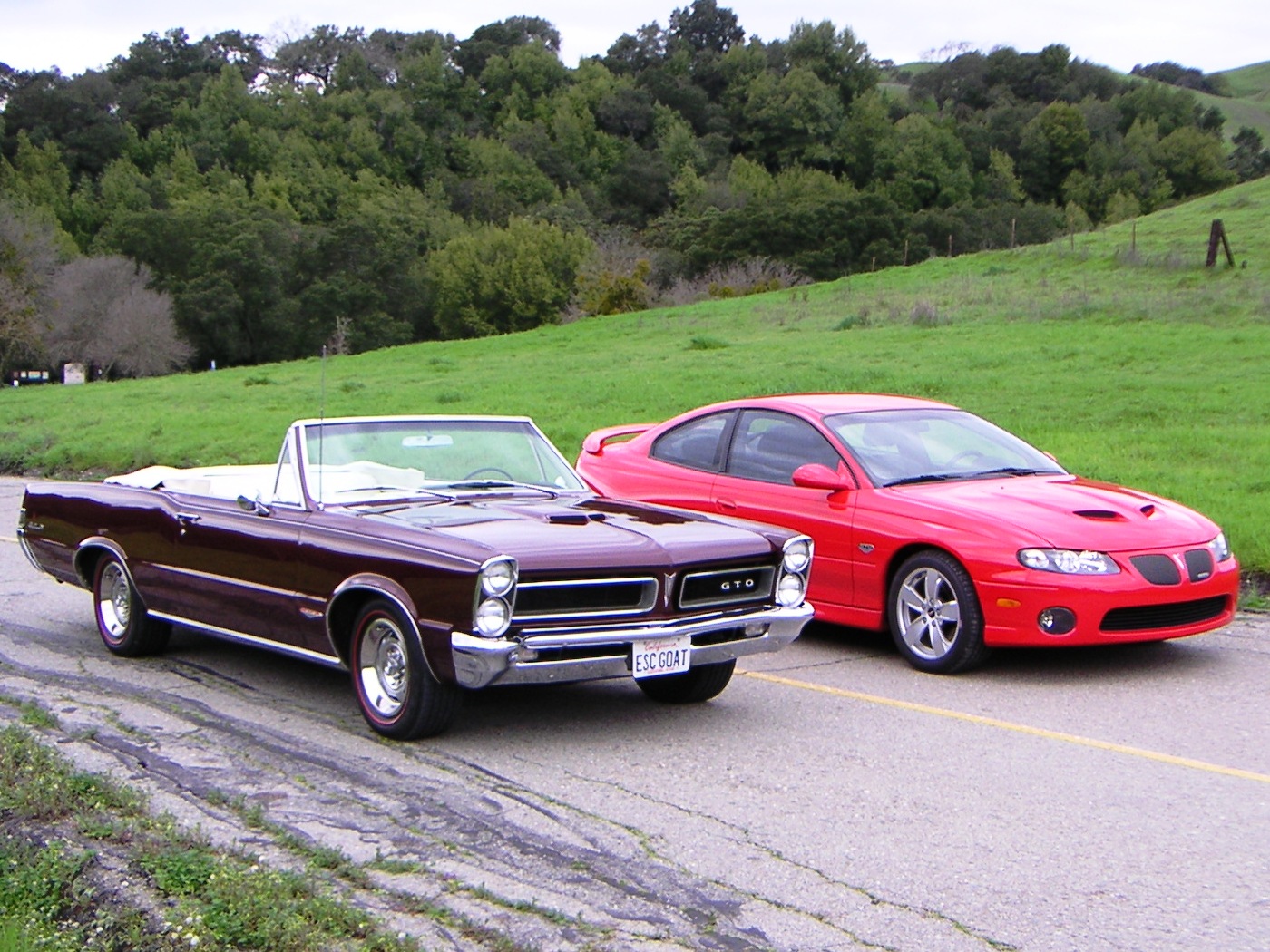
$15,000 Question: Pontiac GTO
Today it's hard to find an original, clean GTO from the golden age of muscle cars for under $20K. But for $15K, you can buy a badged engineered Holden Monaro from the Land Down Under that's gussied up to look like a modern version of the legendary Pontiac.
Saturday, May 7, 2011
Mustang Cool
But then Mustang owners wouldn't park their cars on the lawn. They'd farm it like a NASCAR driver on the infield at Daytona.
Cool. There's a reason why Memphis Raines' unicorn was a modified 1967 Shelby GT500 named Eleanor. Even James Bond drove one in "Diamonds Are Forever". But to me, the coolest one was the 1968 Highland Park Green example Steve McQueen drove in "Bullitt".The original Bullitt Mustang was a basic, stripped down street machine with Torq-Thrust wheels. It prowled the streets of San Francisco with a 390 cubic inch V8 soundtrack. There were two cars built for the movie. One was supposedly destroyed during filming and the other is hidden away somewhere by a reclusive owner who makes JD Salinger look like Donald Trump.
In 2001 and again in 2008/2009, Ford produced a limited edition Bullitt Mustang to commemorate the movie. The new Bullitt Mustangs share the stripped down look of the original. They aren't the fastest or the best handling, or even the most collectible version. They don't have the 390 cubic inch engine or the legendary 5.0, but they are by far my favorite.But no matter what version, the Mustang is cool. It has that It factor. Like a pair of Ray-Bans, jeans or Classic Rock there is an honest, American quality to them. Unlike some of the more expensive and pretentious GT cars, you don't have to put on airs to own one. You just drive it.
Sunday, April 17, 2011
The Lincoln in the Lincoln Lawyer

It's funny how the mind of a car nut works. My wife and I saw "The Lincoln Lawyer" recently, which starred Matthew McConaughey. We both liked the movie, which features tight storytelling, authentic characters, and excellent cinematography.
But I loved the old school 1980s Lincoln.
I know, it's a Town Car. God's waiting room riding on four wheels. It's the kind of car you're buried in, and in fact, many of these cars were turned into hearses. As I look at the car with it's angular body, Landau roof, and acres of chrome, I picture it piloted by a septuagenarian sporting plaid pants with white shoes and a Brylcreemed comb-over.
Abe Vigoda, your car is ready...
And yet, as I watched the Lincoln roll through the streets to the sound of Bobby "Blue" Bland, I couldn't help but think it was cool.
Saturday, March 5, 2011
Auto Show Musings
I went to the KC Auto Show yesterday. Here are some random thoughts & musings:Chrysler, Ford and GM have come a long way in a short time. The quality of the look and feel of their new cars is amazing. Chrysler's new interiors are stunning as are Ford's. GM is finally building cars I'm interested in, including the new Chevrolet Cruze and Buick Regal.
When it comes to imports, Hyundai and Kia are lapping the field on Toyota and Honda. The Korean automakers have always provide a good value at a low price. Now they're turning out stunning designs and workmanship. The new Kia Optima looks better than a Jaguar XF--and I never thought I'd say that. And the Hyundai Elantra looks like it came from the future. I sat in a Mercedes C300 and then the Elantra. Both cars are about the same size, and line up nicely on paper, but you can buy two loaded Elantras for the price of one C300. What's more, the Elantra actually had a nicer interior with its mix of materials, design and colors. Even if they were the same price, I'd still pick the Elantra.
My latest obsession is a Mini Countryman. It's the first Mini you can get four normal sized people in without a shoehorn and some butter. At $27-30K, I thought it was price, but it's everything I want in a car. Unique styling, room for four, all wheel drive, good gas mileage, and loads of fun. I'm sure this obsession will pass eventually--people who genuinely obsess about cars are like serial monogamists or high functioning addicts. And if they have means, they will collect cars like Charlie Sheen collects women and grams of coke. But for those of us with limited means, who have to make due with one car in the garage, the Countryman would be hard to beat.
Saturday, July 31, 2010
Power!
When I was a kid, 200 horsepower was a lot. Most V8s of the early 1980s struggled to reach that number. The Corvette put out between 230-250 horsepower. Same with the Porsche 928, which for a time was the fastest car you could buy in the US. Now you have four cylinder engines that make that amount reliably thanks to turbocharging, and multi-valve direct injection. Six cylinder engines producing 300+ horsepower are not uncommon. Cars like the Chevy Camaro, Ford Mustang, and various Hyundais and Nissans put out that level of power and offer the same level of performance as V8s from just a few years ago.
It truly is exciting times for internal combustion. With smaller, more efficient and more powerful engines coming to market each year, I can't wait to see what's next.
Friday, January 15, 2010
Who Killed the Diesel Car?
On the other hand, diesel powered cars are being killed. Nissan, Toyota, GM, Ford, and Chrysler have all scaled back their plans to produce diesel versions of several popular cars and trucks, or canceled them outright. Only ze Germans—BMW, Mercedes and Volkswagen plan to expand their diesel lineups in the coming months. Germany, if you recall, perfected diesel technology almost a hundred years ago and had diesel-electric hybrids as early as 1915. They were called u-boats.
Diesel is popular in Europe, and I don’t know why it hasn’t caught on in a truck crazy country like the US. The latest batch of diesels offer good performance and get 30-50% better mileage than their gasoline powered counterparts. Diesel versions of the Ford Fiesta and VW Polo routinely get 60-70 mpg in Europe, which is the kind of mileage makes hyper-milers giddy and turns already green Prius owners black with envy.
There is an urban legend about a man who tried to commit suicide by running his new diesel while sitting in the garage. According to the myth, he woke up after a couple of hours feeling refreshed because the tailpipe emissions from his car were actually cleaner than the outside air. I doubt this story is true, but the latest diesels do even meet California’s tough emissions standards.
In “Who Killed the Electric Car,” the demise of GM’s EV1 electric car program was partly blamed on the ignorance of consumers who were largely unaware such a vehicle existed. I suspect the same is also becoming true of the diesel.
Saturday, January 9, 2010
The Best Cars for Snow

My friend Jody, who writes a blog called the AgrOpinion, likes to challenge me with car questions. Recently she asked me what I thought was the best snow car.
In most cases, it would have to be something with all wheel drive or AWD. All wheel drive is different than traditional four wheel drive because all four wheels are always connected to the drivetrain by a fluid-filled center differential. Traditional four wheel drive is a part-time system with a mechanical differential. In two wheel drive mode, only two wheels, typically the rear ones, are connected to the drivetrain. When you encounter slippery conditions, like snow, mud or sand, you can shift into four wheel drive and all four wheels will receive power. The traditional four wheel drive vehicle has more capability for traveling off road, or through deep snow, and are useful for people who live in places called Beaver Camp . But for people who live in suburbia, whose offroad excursions are limited to a snowdrift at the local shopping mall, AWD is the better choice.
Why? The reason is simple--four wheel drive can only be used in slippery conditions. AWD can be driven in any condition and is especially useful for roads that alternate from dry, to wet, to snow packed and back to dry. These conditions describe most of the road conditions in the Midwest this week, even with the record snow and cold temperatures.
There are a number of AWD vehicles on the market. Some are SUVs like the Honda CRV or Ford Flex. Some are normal looking cars made by everyone from Ford and Toyota to premium cars like Audi or Mercedes Benz. There are even high performance sports cars like the Porsche 911 and Lamborghini Gallardo which offer AWD. But my favorite AWD cars are made by a pair of quirky, offbeat car makers called Subaru and Suzuki. It used to be Subarus were only driven by Vermont college professors and Maine housewives who shopped at LL Bean, but anyone who has spent time in a Honda will feel at home in a new Legacy or Outback. Mention Suzuki, and people think "motorcycle" or "that jeep-thingy that flips over" but they make a great small wagon called the SX4, which you can buy new for under $18K.
My personal choice would be the Subaru Legacy GT, with either the 2.5 liter turbocharged engine or the 3.0 V6. It offers AWD with enough performance and creature comfort to make a BMW jealous, and looks that won't make you cringe.


.jpg)