Showing posts with label GM. Show all posts

Tuesday, September 17, 2013

$15,000 Question: Pontiac GTO

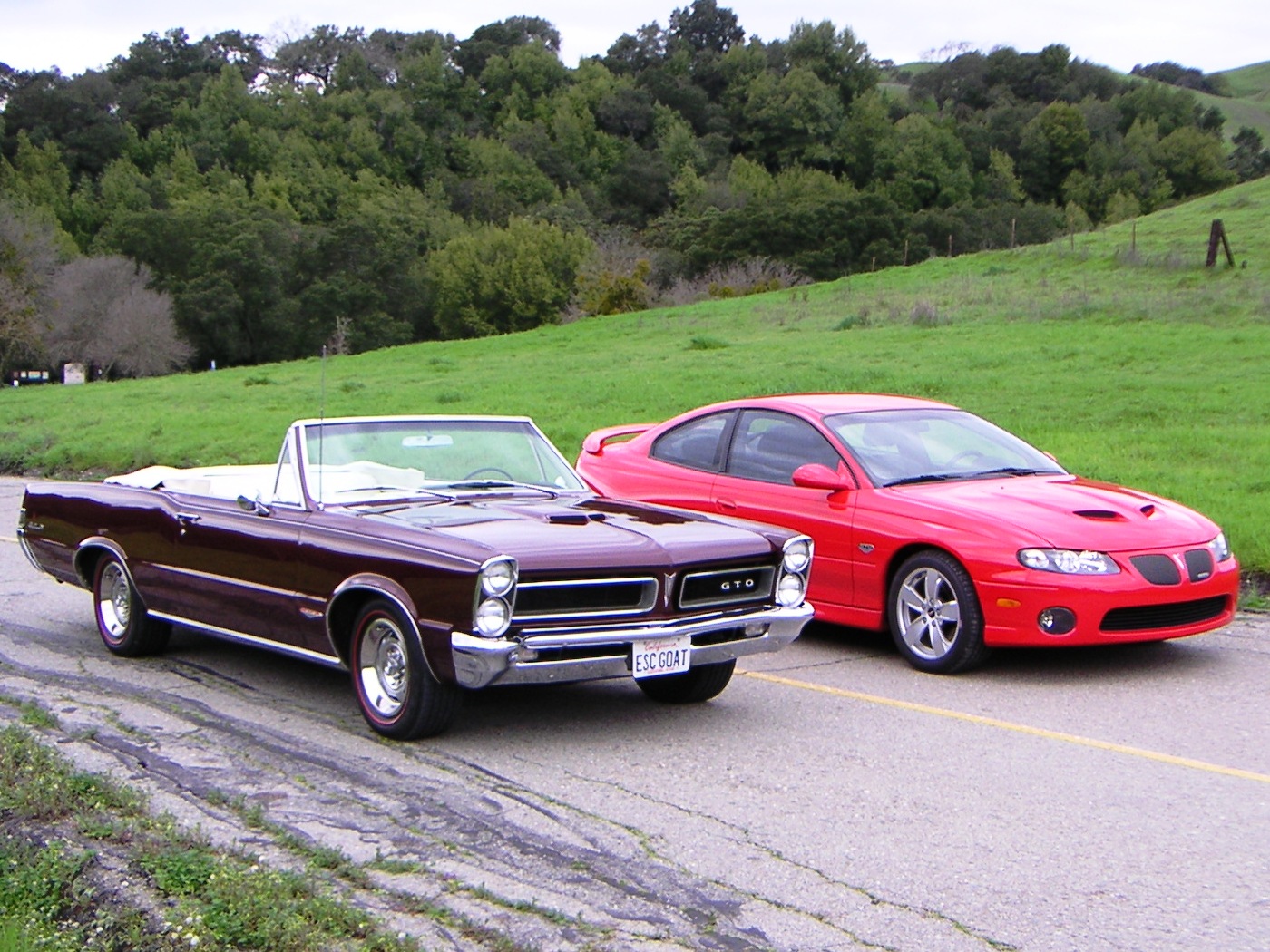
The premise was simple:  Stuff a performance V8 into a midsize car.  The result became the legendary Pontiac GTO and launched the muscle-car era fifty years ago.  Within a year, hot versions of Oldsmobiles, Chevrolets, Buicks, Fords, Mercurys, and Mopars were rolling off showroom floors and on to drag strips across America. 

File:40 Years of GTOs 1965 to 2005.JPG

Today it's hard to find an original, clean GTO from the golden age of muscle cars for under $20K.  But for $15K, you can buy a badged engineered Holden Monaro from the Land Down Under that's gussied up to look like a modern version of the legendary Pontiac. 

File:2001-2002 Holden V2 Monaro CV8 coupe 03.jpg

Admittedly, the idea of an Australian built Pontiac GTO seems like pasting a picture of a Clydesdale on a can of Foster's Lager and calling it Budweiser.  If you look close enough, that's exactly what GM did.  The car looks exactly like a Holden Monaro with the grille of a Pontiac Grand Prix.  Inside it has an interior that looks more at home in an Opel, right down to the Blaupunkt stereo. 


But the biggest problem is that the GTO doesn't stand out.  It doesn't have the presence of the old GTO, or even modern cars like the Ford Mustang or Chrysler 300.  From a distance, it's easily confused for a Chevy Cavalier or the Pontiac version of the Cavalier, whatever it's called. 

All that changes, if you actually drive it.  Powered by the LS1 and LS2 V8 engines from the Corvette, the GTO has serious performance credentials, blasting to 60 MPH in under five seconds and through the quarter mile in 13 seconds flat.  Better still, it sounds great and even handles well with its independent suspension.  
  

It's persona is that of Hugh Jackman, playing Wolverine, hiding in a musical about French peasants, based on a Victor Hugo novel.  Somewhat confusing, but for the budget enthusiast, looking for a V8 powered sleeper, it's really hard to beat. 

Saturday, September 18, 2010

How often should you change your oil?

How often should you change your oil? If you lived in the era of the shade tree mechanic or run a garage, your answer is probably "faithfully every 3,000 miles".

That answer may have been correct in the era of carburetors and bias-ply tires, but not today. Oil, like the cars that use it, has changed over the last thirty to forty years. Now you can go 5,000, 10,000, even 15,000 miles between oil changes. And if you use synthetic oil, that interval is even longer.

Some cars like most late model BMW, Honda and GM cars equipped with OnStar have onboard diagnostic tools to measure remaining oil life. All cars have the recommended service intervals published in their owner's manuals. And all manufacturers now recommend changing the oil between 5,000 and 10,000 miles depending on your driving conditions.

In my opinion, the only time you need to change the oil earlier than 5,000 miles is if you bought a brand new car and want to change the oil after the car's break in period. After that, just follow your owner's manual. Doing so will prevent you from voiding your warranty and save you money.

Saturday, July 31, 2010

Power!

Jeremy Clarkson, the lead presenter for BBC's "Top Gear" television show, is famous for shouting POWER! His yawp is usually reserved for cars by Mercedes and Lamborghini with massive power. But I think even he would agree that the power made by the latest four and six cylinder engines is astonishing.

When I was a kid, 200 horsepower was a lot. Most V8s of the early 1980s struggled to reach that number. The Corvette put out between 230-250 horsepower. Same with the Porsche 928, which for a time was the fastest car you could buy in the US. Now you have four cylinder engines that make that amount reliably thanks to turbocharging, and multi-valve direct injection. Six cylinder engines producing 300+ horsepower are not uncommon. Cars like the Chevy Camaro, Ford Mustang, and various Hyundais and Nissans put out that level of power and offer the same level of performance as V8s from just a few years ago.

It truly is exciting times for internal combustion. With smaller, more efficient and more powerful engines coming to market each year, I can't wait to see what's next.

Thursday, June 10, 2010

Don't Call It a Chevy

There's a rumor going around that the GM corporate brass doesn't want employees referring to Chevrolet as Chevy. It supposedly cheapens the image and dilutes the Chevrolet brand.

Seems crazy to me, but not any more than Ed Whitacre, a former AT&T executive and current GM CEO, appointing himself head of product planning.

Chevrolet makes cars. The company was founded by Louis Chevrolet almost a hundred years ago. But Chevy is an icon. For a time, people were proud to own a Chevy. In the 1960s, a Chevrolet Impala was the family vehicle of choice. Eric Clapton sang about a '57 Chevy. Bob Seger reminisced about his '60 Chevy. And Don McLean sang about how he drove a Chevy to the levy, but the levy was dry.

Then Chevrolet, like the rest of GM, lost it's way. Chevy became a car you didn't want to own, unless you had to. They were cheap, GM's answer to Kia. In high school, my Ford friends referred to a Chevrolet as a "piece of Chevy" as in a piece of crap. And it could be argued they were.

Over the last five or six years, Chevrolet has begun building good cars again. Their trucks were always good--I've always like the Chevy Silverado--but now they have a solid lineup, the likes of which we haven't seen in twenty five years. And people are proud to own them again. If I were in the market today, I'd take a hard look at the Malibu and the Equinox.

But the whole, "Don't call it a Chevy" nonsense bothers me. It's the kind of thing an AT&T executive, the one who brought us those Carrot-Top 1-800-CALL-ATT commercials, would come up with. Now I worry Whitacre will bring back Carrot-Top to star in adds for the On-Star system.

If Carrot-Top were in a car crash, would anybody come?

Likewise, if Ed Whitacre starts designing cars, will anybody buy them? Just when I thought it was safe to wade in and buy a Chevy, I'm worried I might find the brand dried up like Don McLean's levy.

Friday, January 15, 2010

Who Killed the Diesel Car?

In 2006, an independent film called “Who Killed the Electric Car?” explored the demise of the electric car industry in the United States. Just over three years later, it appears the electric car has more lives than a cat. Not only is there a thriving cottage industry for electric cars and electric car conversions, but several major car companies plan to roll out electric cars in the next three years as well.

On the other hand, diesel powered cars are being killed. Nissan, Toyota, GM, Ford, and Chrysler have all scaled back their plans to produce diesel versions of several popular cars and trucks, or canceled them outright. Only ze Germans—BMW, Mercedes and Volkswagen plan to expand their diesel lineups in the coming months. Germany, if you recall, perfected diesel technology almost a hundred years ago and had diesel-electric hybrids as early as 1915. They were called u-boats.

Diesel is popular in Europe, and I don’t know why it hasn’t caught on in a truck crazy country like the US. The latest batch of diesels offer good performance and get 30-50% better mileage than their gasoline powered counterparts. Diesel versions of the Ford Fiesta and VW Polo routinely get 60-70 mpg in Europe, which is the kind of mileage makes hyper-milers giddy and turns already green Prius owners black with envy.

There is an urban legend about a man who tried to commit suicide by running his new diesel while sitting in the garage. According to the myth, he woke up after a couple of hours feeling refreshed because the tailpipe emissions from his car were actually cleaner than the outside air. I doubt this story is true, but the latest diesels do even meet California’s tough emissions standards.

In “Who Killed the Electric Car,” the demise of GM’s EV1 electric car program was partly blamed on the ignorance of consumers who were largely unaware such a vehicle existed. I suspect the same is also becoming true of the diesel.

Wednesday, January 6, 2010

Toyota in Trouble

Last fall Toyota issued a recall to fix issues related to unintended acceleration on a majority of their cars and light trucks. The problem could have ballooned into the one that almost destroyed Audi twenty years ago. But instead of mechanical problems, faulty engineering, or demonic possession, the fault was attributed to floormats.

At about the same time, it was announced that Toyota is losing market share and posted quarterly losses--not to the level of GM, which Toyota eclipsed last year as the world's largest car manufacturer, but surprising all the same. More recently Toyota has announced they will begin cutting costs by lowering product content and using cheaper suppliers.

Uh oh.

We've seen this before with GM, Ford and Chrysler. And if Toyota follows the Big Three's model for making cheap cars and offering generous rebates, they too will be in trouble.

Friday, December 4, 2009

GM on the Fritz

In a surprising move this week, GM dismissed CEO Fritz Henderson and granted Saab a stay of execution. Henderson, who took over GM after Rick Waggoner was forced out earlier this year, had been with GM for 25 years.

I suspect Henderson was asked to resign because he was too much of a company man, too much of the "old way" of doing business that has plagued GM since before his arrival. GM's board of directors are probably envious of what Ford has accomplished when they hired Alan Mulally, whose last stop was at a little aircraft firm known as Boeing. Mulally put Ford in a position where it didn't require a bailout, and is now launching a revamped line of products that are winning awards from the automotive press. GM is still struggling to sell Saab and Hummer, a process which has taken twice as long as their bankruptcy proceedings. Apparently the drawn out process of selling GM's non-core brands has caused deals for Saab and Saturn to fall through and put Hummer at risk.

Friday, November 27, 2009

A Saab Story

Saab has just been taken off life support and is expected to die in the next week. Koenigsegg pulled out of the deal earlier this week and today the Swedish government announced they will not bail out the company if GM chooses to liquidate it.

Until it was assimilated by the Borg-like GM, Saab was known for making quirky, performance oriented hatchbacks. Afterwards they churned out re-skinned Chevy Malibus and Trailblazers. The result was predictably bad. The Muselix and Birkenstock crowd who bought Saabs departed for Subaru. Before long, Saab's only customers were a handful of Minnesota farmers named Olsen who were trying to get back in touch with the old country. "Traded the Tahoe on a new 9-5 did ya?" "Oh yah, you betcha! It goes through the sno' like a hot knife through tapioca..."

I hate to see Saab leave the automotive landscape. But the company has become yesterday's lutefisk.

Friday, November 13, 2009

Buick Regal, Sports Sedan

I'm having a hard time saying Buick Regal and sports sedan in the same sentence with a straight face. It's an oxymoron, but that's what GM is positioning the Regal as for its relaunch next year.

To be fair the new Regal will be based on the Opel Insignia, which has won accolades in Europe. Buick is also undertaking a huge effort to remake itself, much like Cadillac did ten years ago. And the new LaCrosse makes me think they're on to something.

Still, to position the car to compete with Acura, BMW and Infiniti, and use a stodgy nameplate like the Regal, is like Country musician Taylor Swift changing her name to Blanche or Patsy. Yes, there's a history there, but the connotation is not attractive. Buick has better names for a sports sedan like the Wildcat or Gran Sport. The Regal hasn't been cool since the Grand National came out 25 years ago, and people who own those cars don't call them Regals.

I hope Buick is successful. But to be successful, I think they need an attitude car, or halo car as it's known in the industry. Something like the Grand National that will draw Acura customers into the showroom and leave with a new Regal or LaCrosse.

Saturday, October 24, 2009

I Miss Pop-Up Lights

Although the 1980s are not considered a high watermark of automotive design there was one element from that era that is missing today. Pop-up headlights.

Pop-up and hidden lights originated in the 1930s with cars like the Cord 810 and the Buick Y-Job concept car. They reappeared in the 1960s on the Corvette, Buick Rivera, Pontiac GTO and Dodge Charger. Before long they spread to Italian makes like Lamborghini, Ferrari and Alfa Romeo. But they were the most prevalent in the 1980s, appearing on everything from exotic cars to Hondas and Toyotas. They came in all styles and shapes, from ones that flipped up, like on the Honda Prelude, to ones that rotated 180 degrees like on the Corvette C4. There were also exposed pop-up lights like the ones on the Porsche 928 and the 1982 Toyota Celica that I owned in college.

Fifteen years later, pop-up lights have all but vanished. The last new car with pop-ups was either the 1997-2004 Corvette or Lotus Esprit. I know a big reason they went away is cost. Fixed lights are cheaper to produce and less expensive to repair. They also weigh less and take up less space. And like most styling trends, they were a bit of a fad as well, like tail fins, digital instruments and talking cars. But like most fads, it's only a matter of time before they reappear. If the Chevrolet Camaro, Ford Mustang, and Dodge Challenger are any indicator, I suspect we'll see pop-up lights again in the near future.

Saturday, October 3, 2009

R.I.P. Saturn


Saturn is dead, but in truth the lineup has been in God's waiting room for quite some time because of its lousy lineup of warmed over Opels and other GM vehicles.

The concept was good, just poorly executed. Saturn sold cars at a fixed price and provided a superior ownership experience. The company was constantly rated at the top in consumer satisfaction and brand loyalty. But loyalty will only get you so far if you're not profitable or can't offer a consistently good product. Just ask Saab.

When Roger Penske stepped in, I hoped he would find a way to turn the company around. But it was not to be. In what was perhaps his most savvy display of business acumen, Penske pulled the plug on the deal this week. Both on and off the racetrack, Penske has proven to be a shrewd business operator. Knowing a deal is sour and walking away takes more guts than standing pat or pushing a bad position.

Sadly this lack of guts sealed the fate of Saturn. GM could never seem to find a way to consistently position the brand. Or follow through on the execution. Saturn started out a niche brand but GM wanted to morph it into a replacement for Oldsmobile. I never understood why Saturn didn't offer the Vibe instead of Pontiac, or even the Geo lineup before it was killed off a few years back. Both the Vibe and the Prizm were made in a joint venture between Toyota and GM at their NUMMI plant in California and were good cars.

Like everything else, GM pushed volume over profitability. Saturn was treated as an afterthought, a factory outlet store built outside city limits to peddle imperfect merchandise or last year's fashions. Rumor has it the late Roger Smith championed Saturn to "get even" with the UAW, Japan and just about everyone else. The rumor is plausible. Smith was vindictive on a level that makes Richard Nixon look like Will Smith.

Saturday, September 5, 2009

10 Cars for $10K - 80s Collectibles

The average car nut is usually forced to make a choice. Buy a reliable daily driver and a toy or one car to fit both requirements. The second route is straightforward. Instead of opting for a Camry, like most normal people, the car nut picks something like a Mini Cooper, Dodge Challenger, or BMW M3--all of which have a degree of practicality but can also induce face splitting grins on demand.

The other route is more difficult, requiring a balancing act and a very understanding spouse. Spend too much on the toy and you're likely to own a daily driver that will have you taking the bus. Spend too much on the daily driver and you're the owner of a toy that sits on blocks or lurks in boxes.

However, there are cars out there that make this balancing act easier and can be had for less than ten grand in good, if not excellent, condition. The following is a list of ten cars from the 1980s, a decade enthusiasts only recently began scavenging for collector cars. While this is by no means a complete list, each of these cars should appreciate in value and are fun to drive.

1. Alfa Romeo Spider - The car Dustin Hoffman drove in The Graduate was still in production when he did Rain Man. The 1980s version may lack the clean lines of the original but is less temperamental. The Pininfarina styling holds up well today and the driving experience is light and crisp, like a Pinot Grigio.

2. Audi Quattro - Before Audi became synonymous with unintended acceleration, it made a name for itself in the rally racing world with the Quattro. The turbo-charged all-wheel drive sports coupes were almost as fast as pure sports cars of that era and set the standard for cars like the Subaru WRX and Mitsubishi Lancer Evo.

3. Chevrolet Camaro IROC-Z - Think Camaro and the brain conjurs up an image of the mullet wearing high school bully who prowls the streets in a primer and Bondo Z-28 with Poison blaring from his Pioneer cassette deck. But the IROC, named for the International Race of Champions, offers Corvette like performance in a 2+2 coupe or convertible.

4. Chevrolet Corvette - Love or hate the Tron inspired digital gauges, the C4 Corvette offers clean looks and world class performance. Convertibles may be out of the $10 grand price range, but you can still pick up a well maintained coupe. Avoid the 1984-85 models which had the Crossfire fuel injection and rattle trap suspensions.

5. Ford Mustang - I couldn't put the Camaro on this list and leave off the Mustang. While I'm not crazy about the 1987-92 GT with its junky add-ons, you can't go wrong with any of the 5.0 liter cars or the turbocharged SVO.

6. Honda CRX - This car is a favorite of autocrossers everywhere. Light, quick and cheap, with bulletproof Civic drivetrains, this car is pure fun to drive. The only downside is that so many of them have been bastardized by the import tuner crowd.

7. Jaguar XJ-S - The Jag is a classic grand touring car with a smooth V12 engine and a cockpit like an olde English study. You can find good examples under $10K because the car has a reputation for being more temperamental and unreliable than Lindsey Lohan. Some of that reputation is deserved, but for my money, nothing in this price range touches it for looks and style.

8. Mazda RX-7 - Like the CRX, the RX-7 is light, quick, cheap to run and a blast to drive. It's also the only car on the planet powered by the turbine like Wankel rotary engine. Collectors prefer the looks of the first generation car, but the 1986-1992 models offer better performance and the lineup includes a roadster.

9. Porsche 944 - The 944 is brilliance masked by subtlety. You can have a mild mannered base model, or the outrageously quick Turbo or S2. All versions are equally competent as a track cars or daily drivers.

10. VW Rabbit GTI - The original hot hatch. Think Quattro-lite without the all-wheel drive and at a fraction of the price.
Friday, August 14, 2009

Same Old GM

This week GM trotted out the Chevy Volt again. This time to announce the car gets a stunning 239 mpg as estimated by the EPA. Whether the Volt gets 239 mpg or just half that number, it’s a major achievement. But there is one problem with the Volt. It’s made by GM.

Forty years ago, GM made cars that were aspirations. In the days they controlled 50% of the market, their cars were beautifully styled and well made. People were proud to own a Chevrolet. Pontiacs were bad boys in muscle shirts. A Buick or Oldsmobile in the driveway indicated you were squarely middle class. With a Cadillac, you were someone to be reckoned with.

GM lost its way in the 1970s. With the oil embargo, strict emission standards, and labor strikes it stopped dictating the market and began second guessing itself. Innovation was stifled by a heavy handed corporate culture that made the Soviet Politburo look like Google. Lately GM has started to recover some of its edge. Cadillac and Chevrolet are making good vehicles again and even Buick is showing signs of life.

But the product gestation period is too long. It takes GM at least five years to launch a new vehicle, twice as long as most other companies. And GM flaunts their cars years before they are ready. Cars like the Camaro and Volt are old news before they are finally launched. I get that the drive train technology for the Volt needs time to be developed, but five years for a Camaro that looks like a cartooned evil twin of the 1969 model?

C'mon GM.

Tuesday, June 23, 2009

Big Three Win J.D. Power Awards


For a time in the 1990s, all my friends and I drove Hondas. I'm not exactly sure why but maybe it was a combination of herd mentality in twenty-something adults, who yearn to be different, coupled with an evolving sensibility that let us escape our teen years largely intact. Hondas looked nice and were quality made automobiles that rarely broke. By comparison, nearly everyone I knew was skeptical of cars made by GM, Ford, and Chrysler because we perceived they lacked those same qualities.

Styling and quality are subjective. We all have our own notions of what looks good and our own standards of quality. I owned a 1996 Accord and have always thought it was one of the best looking, highest quality cars Honda ever made. You may agree with my opinion or might think I was dropped as a baby.

Like most people, my opinions are based on my experience, the opinions of people I respect, and the facts as I choose to interpret them. Part of my opinion of Hondas, and my perception about the quality of any car, is based on the findings of J.D. Power and Associates. Like the old E.F. Hutton saying, when J.D. Power talks, I listen.

This week J.D. Power came out with the results of their Initial Quality Study for 2009. This study measures the problems new car owners experience within the first 90 days of ownership. The results for 2009 showed many of the top ranked cars were made by the Big Three. Cars like the Chevy Malibu, Pontiac G6, Ford Mustang, Mercury Sable and Chrysler PT Cruiser scored as well or higher in this survey than similar cars made by Honda, Toyota and Lexus.

This news surprised a lot of people, but it shouldn't. Detroit has always made some very good cars. Bob Lutz has been saying this for years, and as the ultimate car guy, he should know. Lutz has worked for BMW, Ford, Chrysler and in 2002 he became GM's self appointed car czar. At the launch of the Pontiac G6, he stated that the quality of GM cars was as good as the imports. GM just needed to do a better job of getting the word out.

The word is now out. If I were in the market today, I would be hard pressed not to consider buying something from the Big Three. The cars on J.D. Power's list are quality vehicles offering a tremendous value in price and content. Many of them carry huge rebates or financing incentives. And to my eye, they offer good stying as well.